
1. Removal from the tunnel
The thruster is removed from the hull tunnel as a complete unit. Everything downstream depends on this going cleanly: the unit is lifted on its designed lifting points, the tunnel opening is protected, and the unit is transported to the workshop on a stand that supports it in the attitude it runs in.
2. Strip-down and cleaning
In the workshop the unit is fully dismantled and every part cleaned. Cleaning is not housekeeping here, it is the step that makes measurement possible: a gear tooth with oil and carbon on it cannot be read for pitting, and a bearing cannot be felt for roughness until it is clean.
3. Measurement and inspection
This is the step that decides the whole job, and it has to be recorded part by part.
Seals. Every oil seal, O-ring and gasket is checked for hardening, wear and deformation. Age is judged by feel and by the shape the lip has taken, not by appearance alone.
Bearings. Rolling elements and both rings are checked for wear, and radial and axial clearance are measured and written down.
Gears. On the bevel gear set, the tooth contact pattern is read, pitting and wear are checked, and the backlash is measured.
Shafting. Radial run-out and wear are measured on the propeller shaft and the input shaft.
4. What is replaced
On a five-year strip-down three categories are replaced as a matter of course: the complete seal set, including oil seals, O-rings and gaskets; every bearing that has reached its wear limit; and any gear that shows pitting or is outside wear tolerance.
The point of measuring first is the other side of it: bearings and gears that are inside tolerance are kept. A five-year service that replaces everything whether it needs it or not is not a maintenance decision.
5. Propeller blade repair and balancing
Blades are built up by welding where the edges are worn or eroded, the profile is measured, and the blade is balanced and polished. Unbalanced blades put the load back into the shaft and the bearings that were just measured, so this step protects the rest of the work.
6. Assembly and clearance setting
The unit is assembled to the manual, and two clearances are set with care: bearing clearance, radial and axial, and gear mesh backlash. Both are set with the shims the manual calls for after measurement, not by feel.
7. Testing
Tightness. The oil spaces are tested, by air or by hydraulic pressure, before any oil goes in.
Pitch test. On a CPP unit the pitch control is run through its full range and the feedback accuracy is checked against the command.
Running test. The unit is run on the test bed, no-load and then loaded, with vibration, noise, oil temperature and oil pressure recorded.
8. Refit and trials
The unit goes back to the yard and back into the tunnel, followed by the alignment check and the mooring and sea trials. A unit that tested well on the bench and is noisy in the vessel has an alignment problem, not a thruster problem, and this is where that is found.
Five-year inspection points
Seal system: shaft seal, O-rings, oil seals — all renewed regardless of appearance.
Bearings: all rolling bearings — clearance measured, replaced if out of tolerance.
Gears: bevel gear teeth — pitting, wear and contact pattern checked.
Shafting: propeller shaft and input shaft — run-out and wear measured.
Blades: edges and profile — repaired, balanced and polished.
Control system: pitch feedback and sensors — calibrated, replaced if necessary.
Lubrication: oil ways, oil pump and filters — cleaned, filter elements renewed.
Corrosion protection: housing and flange faces — cleaned back and recoated.
Photographs
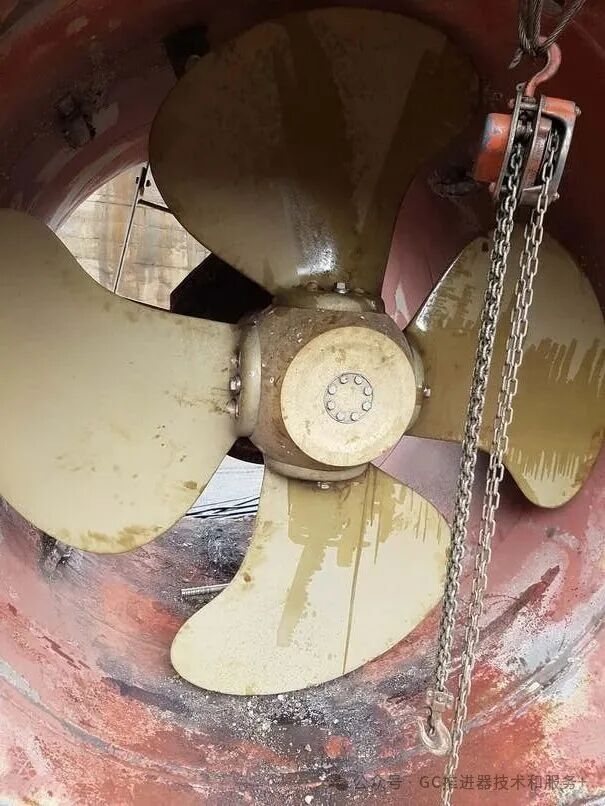
Propeller end of the unit on the stand 试验台上放置的侧推浆端
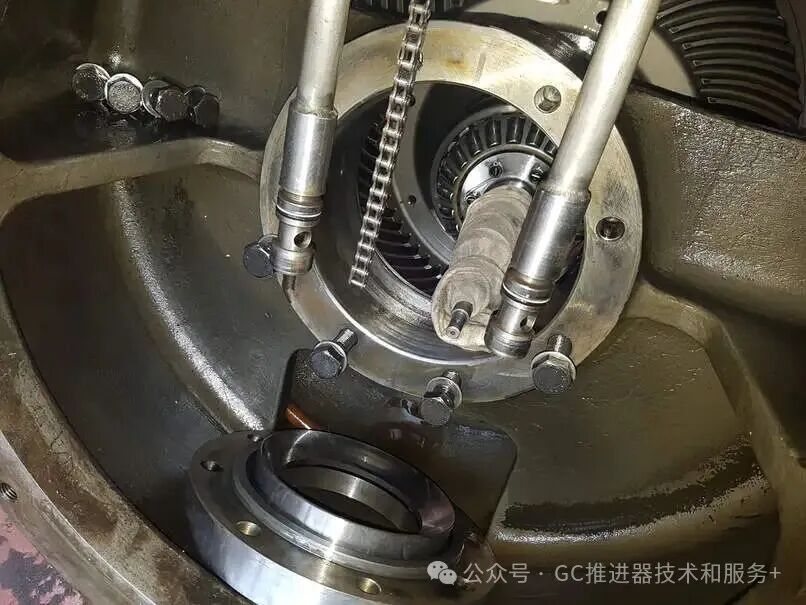
Bevel gear set after cleaning 清洗后的伞形齿轮组
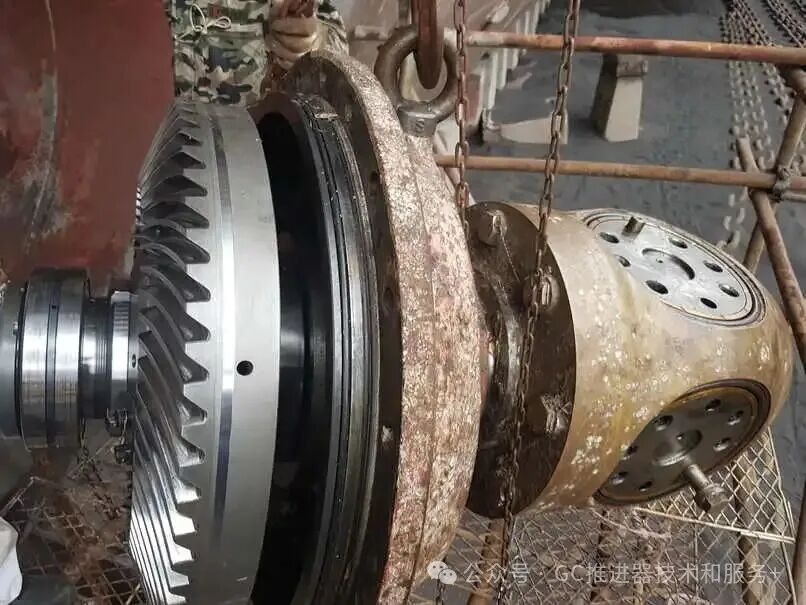
Gear and bearing inspection 齿轮与轴承检查
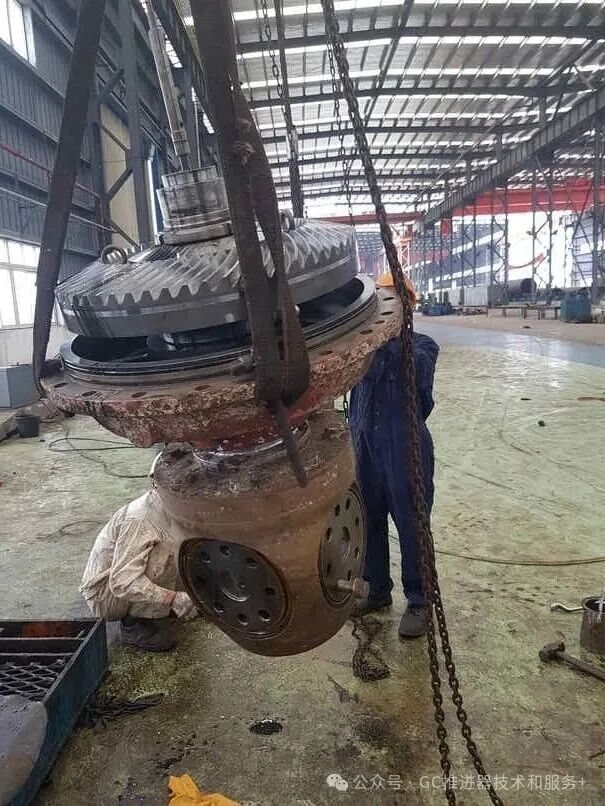
Unit lifted for transport back to the yard 吊装运回船厂